

Do You Know How Much Your Mobile Emitted Radiation? Every day we spend hours with our smartphones—whether for calls, social media, streaming, or work. But have you ever thought about smartphone radiation emissions and how much your mobile actually emits?
What Are Smartphone Radiation Emissions (SAR)?
SAR (Specific Absorption Rate) measures the rate at which the body absorbs electromagnetic radiation from a smartphone. The higher the SAR value, the more radiation your body absorbs while using the device.
📌 Important Fact: In most countries, including the U.S. and Europe, the legal SAR limit is 1.6–2.0 W/kg, ensuring phones remain within “safe” levels.
Smartphones With the Highest Smartphone Radiation Emissions in 2025
Some popular smartphones exceed others by a large margin in radiation output. According to updated SAR databases, the following devices have some of the highest smartphone radiation emissions:
- Motorola Edge (SAR ~1.79 W/kg)
- Sony Xperia XA2 Plus (SAR ~1.41 W/kg)
- Google Pixel 3 XL (SAR ~1.39 W/kg)
⚠️ While these phones remain within regulatory limits, their SAR values are close to the maximum threshold. Prolonged use near your head could lead to higher radiation exposure.
Low-SAR Phones: Safer Alternatives With Lower Smartphone Radiation Emissions
If reducing smartphone radiation emissions is your priority, here are some safer options:
- ZTE Blade V10 (SAR ~0.13 W/kg)
- Samsung Galaxy Note 10+ (SAR ~0.19 W/kg)
- LG G7 ThinQ (SAR ~0.24 W/kg)
These models show that advanced smartphones don’t always need to push SAR levels close to the limit.
How Much Smartphone Radiation Emissions Are Safe for Humans?
International health bodies like the World Health Organization (WHO) and U.S. Federal Communications Commission (FCC) have set SAR limits to ensure safety:
- USA (FCC limit): 1.6 W/kg
- Europe (ICNIRP limit): 2.0 W/kg
👉 While these are considered safe, some scientists suggest minimizing exposure by:
- Using speaker mode or earphones during long calls.
- Keeping the phone away from your body (avoid carrying in pockets close to skin).
- Choosing low-SAR phones when upgrading.
Radiation from phones is measured using SAR (Specific Absorption Rate). This tells us how much radiofrequency (RF) energy your body absorbs while using your phone. Let’s break it down clearly.
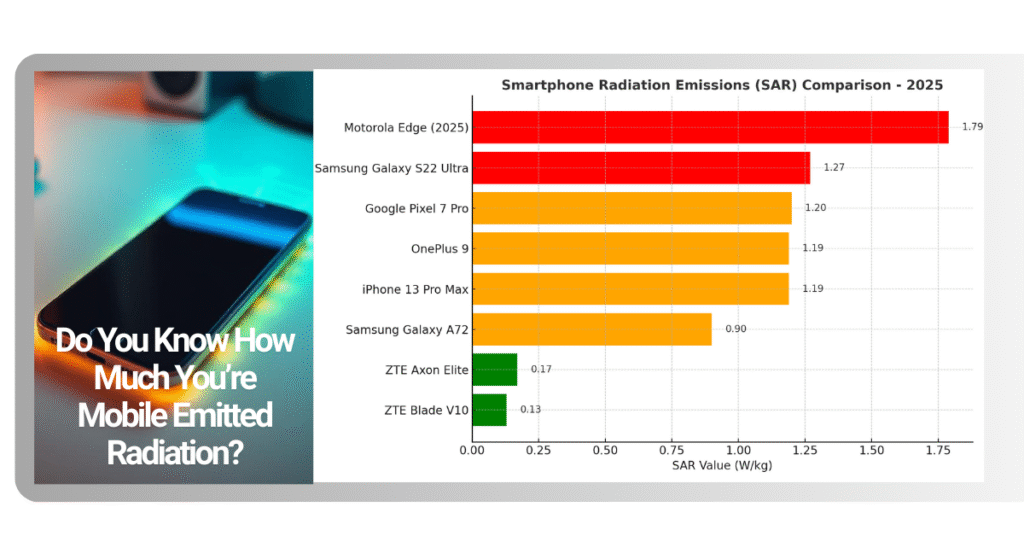
Global Safety Standards:
- United States (FCC limit): Maximum 1.6 W/kg (measured over 1g of tissue).
- European Union (EU limit): Maximum 2.0 W/kg (measured over 10g of tissue).
👉 Any phone below these limits is legally safe, but lower SAR values are generally considered healthier in the long run.

Smartphones With the Highest and Lowest SAR in 2025
Here’s a quick look at which smartphones emit the most radiation vs. which emit the least:
| Brand & Model | SAR Value (W/kg) | Radiation Level | Category |
| Motorola Edge (2025) | 1.79 | High | Flagship |
| Samsung Galaxy S22 Ultra | 1.27 | Medium-High | Premium |
| Google Pixel 7 Pro | 1.20 | Medium-High | Premium |
| OnePlus 9 | 1.19 | Medium | Premium |
| iPhone 13 Pro Max | 1.19 | Medium | Premium |
| Samsung Galaxy A72 | 0.90 | Moderate | Mid-range |
| ZTE Axon Elite | 0.17 | Very Low | Mid-range |
| ZTE Blade V10 | 0.13 | Extremely Low | Budget |
📌 Observation:
- Motorola Edge tops the list with the highest SAR (1.79 W/kg)—still legal but very close to the U.S. safety limit.
- ZTE phones are champions of low radiation, some nearly 10x lower than high-SAR models.
- Apple and Samsung premium models often fall into the medium range.
Suggested Sources for Credibility:
- WHO – Electromagnetic Fields and Public Health
- FCC – SAR Information
- National Cancer Institute – Cell Phones and Cancer Risk
- Statista – Phones with Lowest Radiation
- Visual Capitalist – Radiation Emissions of Popular Smartphones
Pros and Cons of High vs. Low SAR Phones
✅ Pros of High-SAR Phones
- Usually flagship devices with cutting-edge features.
- Stronger connectivity (5G, faster speeds, better antennas).
❌ Cons of High-SAR Phones
- Emit more RF radiation compared to safer alternatives.
- May cause concern for health-conscious users.
✅ Pros of Low-SAR Phones
- Lower exposure to radiation → peace of mind.
- Often more affordable.
❌ Cons of Low-SAR Phones
- Sometimes lack premium features (camera, display, performance).
- Fewer flagship models available in low-SAR range.
Should You Be Concerned?
According to the World Health Organization (WHO) and National Cancer Institute (NCI):
- No direct evidence links mobile phone radiation to cancer or severe health issues.
- Radiation levels in all modern phones are within legal safety limits.
- However, people who want to minimize exposure should choose low-SAR phones or follow safety practices.
How to Reduce Exposure From Smartphone Radiation Emissions
- Use speakerphone or earphones instead of holding the phone to your ear.
- Avoid keeping your phone in your pocket for long periods.
- Text instead of calling when possible.
- Turn off Bluetooth/Wi-Fi when not needed.
- Choose low-SAR models if you’re buying a new device.
FAQs on Smartphone Radiation Emissions
Q1: What is the maximum safe SAR value for humans?
👉 In the U.S., phones must stay below 1.6 W/kg. In Europe, the limit is 2.0 W/kg. Anything under these limits is considered safe.
Q2: Which brand has the highest SAR phones?
👉 Motorola Edge (2025) is among the highest at 1.79 W/kg.
Q3: Which brand has the lowest SAR phones?
👉 ZTE (Blade V10 at 0.13 W/kg) and Axon Elite (0.17 W/kg) are among the lowest in the world.
Q4: Do 5G phones emit more radiation than 4G?
👉 Not always. Radiation depends more on phone design than network type. Some 5G phones have lower SAR than older 4G models.
Q5: Is mobile radiation harmful for kids?
👉 Children may absorb radiation differently. Experts recommend limiting direct, prolonged phone use for kids.
Final Thoughts
Your phone is an essential tool, but it also emits smartphone radiation emissions. While all modern devices comply with safety regulations, the SAR value varies greatly across brands.
- If you prioritize performance, you’ll likely use higher-SAR flagship phones.
- If you prioritize health safety, low-SAR models like ZTE Blade V10 or Axon Elite are the smarter choice.
At the end of the day, awareness is key. Knowing your phone’s SAR helps you balance technology and health with confidence.


