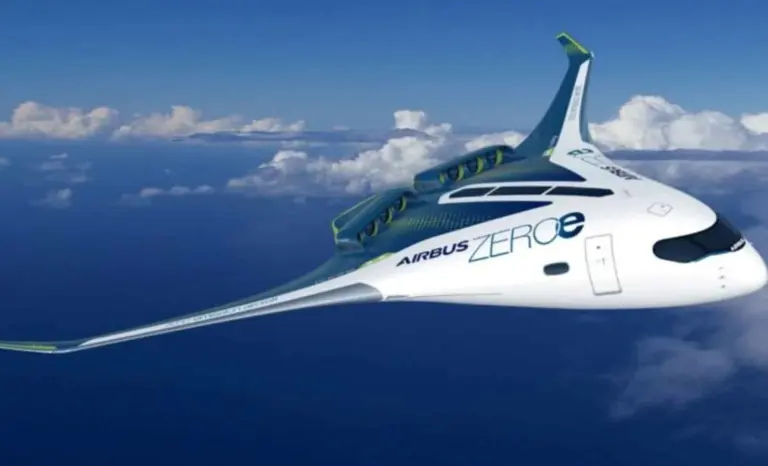

In a significant stride toward sustainable aviation, Airbus has introduced the ZEROe project, aiming to develop the world’s first zero-emission commercial aircraft powered by hydrogen. This initiative underscores Airbus’s commitment to revolutionizing air travel by reducing its environmental footprint.Aerospace Testing International+6Airbus+6Lloyd Alter+6
Hydrogen Propulsion: The Core of ZEROe
Launched in 2020, the ZEROe project explores two primary hydrogen propulsion technologies: hydrogen combustion and hydrogen fuel cells. After extensive research and testing, Airbus announced in 2025 that the future aircraft would utilize hydrogen fuel cell technology. This decision was bolstered by successful fuel cell prototype tests and advancements in cryogenic technology. Ecoportal+2Airbus+2Airbus+2Ecoportal
Innovative Aircraft Design
The envisioned ZEROe aircraft will feature a fully electric propeller propulsion system powered by hydrogen fuel cells. These fuel cells convert hydrogen into electricity through a chemical reaction, emitting only water as a byproduct. This process ensures that the aircraft operates with minimal carbon emissions, provided the hydrogen is produced using renewable energy sources. The design includes four propellers, each driven by its own fuel cell stack. Ecoportal+7Airbus+7Airbus+7GreenAir News+2Airbus+2Airbus+2
Addressing Technological Challenges
While hydrogen fuel cells are not a new concept, scaling them to power a commercial aircraft presents significant challenges, particularly concerning weight and safety regulations. To tackle this, Airbus established Aerostack, a joint venture with ElringKlinger, in 2020. By 2023, this collaboration achieved a milestone with a fuel cell demonstrator successfully powering on at 1.2 megawatts. Airbus+1Airbus+1Cadena SER+3Airbus+3Airbus+3
Infrastructure and Ecosystem Development
Recognizing the need for a robust hydrogen ecosystem to support hydrogen-powered flight, Airbus initiated the Hydrogen Hubs at Airports program. This collaborative effort brings together airlines, airports, energy providers, and technology specialists to address challenges related to hydrogen production, storage, and distribution. The program has garnered participation from over 220 airports, alongside numerous energy providers and airlines. Lloyd Alter+5Airbus+5Airbus+5
Revised Timeline and Commitment
Initially targeting a 2035 entry into service, Airbus has adjusted the ZEROe project timeline to the latter half of the 2030s, acknowledging the technological and regulatory challenges ahead. Despite this shift, Airbus remains steadfast in its dedication to decarbonizing aviation and advancing hydrogen as a viable alternative to conventional fuels. Lloyd Alter+2GreenAir News+2Cadena SER+2
Conclusion
The ZEROe project represents a bold step toward sustainable aviation, with hydrogen propulsion at its core. Through innovative design, strategic partnerships, and a commitment to overcoming technological challenges, Airbus is poised to lead the industry into a new era of environmentally friendly air travel.Airbus


Pingback: Starlink India Launch 2025: Price, Speed & Coverage Details